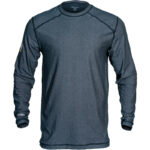
FR Base Layers?
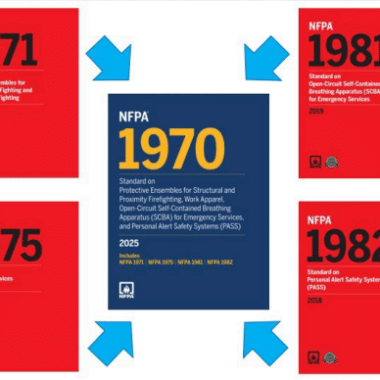
While NFPA 1970 – Work Apparel, formerly NFPA 1975, establishes performance requirements for stationwear garments, its scope does not extend to the evaluation or certification of base layers or undergarments worn beneath those uniforms.
Base layers can directly influence thermal injury outcomes by affecting:
- Heat transfer to the skin
- Moisture retention and evaporation behavior
- Fabric melting, shrinkage, or adhesion under heat exposure
Because NFPA 1970 – Work Apparel, formerly NFPA 1975 certification applies only to the outer garment, non-FR base layers may introduce unintended burn risk, even when worn under a compliant uniform. Cotton blends, synthetics, or athletic fabrics may ignite, melt, or retain moisture in ways that increase thermal injury severity during incidental exposure.
NFPA 1970 – Work Apparel, formerly NFPA 1975 does not evaluate or certify base layers. As a result, base-layer selection must be assessed independently, based on material behavior under heat, moisture management characteristics, and all season / all day comfort.
For this reason, we recommend FR base layers like DragonWear .
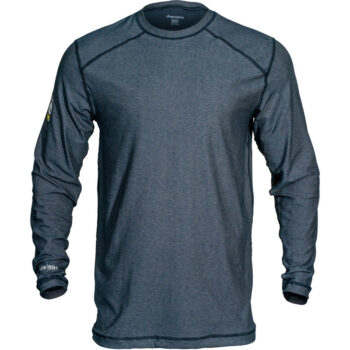
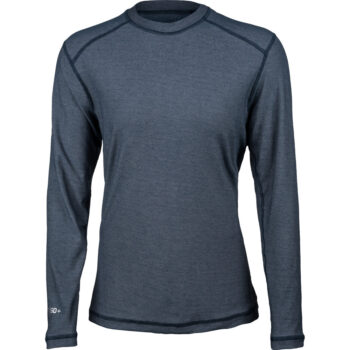


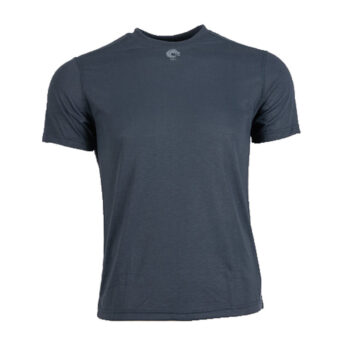
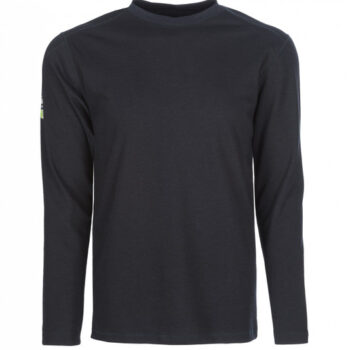
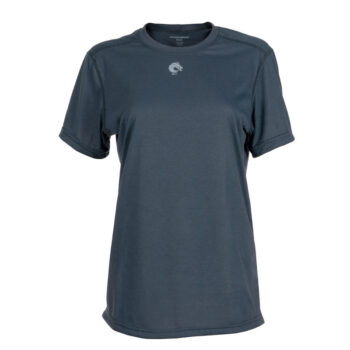
Why NFPA 1970 – Work Apparel (Formerly NFPA 1975) Certification Applies Only to the Finished Garment
For station and work-uniform applications, certified outer garments provide verified performance only within their defined scope of use and only as a finished garment. With the consolidation of NFPA 1975 into NFPA 1970, this principle remains unchanged—and in many ways is now more clearly defined.
Unlike standards such as NFPA 2112, which evaluate layered clothing systems using full-scale manikin testing, NFPA 1970 work-apparel requirements rely on material- and garment-level performance criteria. The standard is intentionally structured this way to avoid implying system-level protection where none is formally evaluated.
Understanding where NFPA 1970 certification begins and ends is critical to avoiding unintended protection gaps when garments are worn as part of a layered clothing ensemble.
Certification Is Applied at the Finished-Garment Level
Under NFPA 1970 (Work Apparel), certification is applied to the completed garment as manufactured and tested. While fabric selection, component compatibility, construction quality, and durability all influence whether a garment can achieve certification, the evaluation does not extend beyond the finished outer garment.
NFPA 1970 does not certify:
- individual fabrics in isolation
- partial garment assemblies
- multi-layer clothing systems
The certification mark applies only to the garment configuration that was submitted, tested, and approved.
What NFPA 1970 Certification Does Not Cover
As a result, certification to NFPA 1970 (Work Apparel) does not extend to:
- Undergarments or base layers
- Interactions between multiple garments worn together
- System-level thermal or burn performance of layered clothing assemblies
Base layers, compression garments, underwear, and similar items remain outside the scope of NFPA certification, even when constructed from flame-resistant or non-melting materials. While such garments may be engineered responsibly and tested to material-level methods (e.g., vertical flammability), they are not evaluated or approved as PPE under NFPA 1970.