Understanding NFPA 1977 and NFPA 1975 Test Methods
Protective clothing for firefighters and emergency service personnel is governed by NFPA standards that define minimum performance requirements, test methods, and certification criteria for specific use environments. Two commonly referenced standards are NFPA 1977, which applies to wildland firefighting protective clothing and equipment, and NFPA 1975, which covers station and work uniforms used in non-structural firefighting activities.
While both standards address flame exposure and garment durability, they are fundamentally different in intended use, exposure assumptions, and performance thresholds. Understanding how each standard evaluates garments—and what those evaluations are designed to represent—is essential for selecting apparel that aligns with real-world operational risks.
NFPA 1977: Wildland Firefighting Protective Clothing and Equipment
NFPA 1977 establishes performance requirements for garments, helmets, gloves, and footwear used during wildland firefighting operations. The standard assumes direct exposure to flame, radiant heat, abrasive terrain, and sustained physical activity, and its test methods are structured accordingly. Certification applies to the finished garment, not individual fabrics alone.
Flame Resistance
ASTM D6413 – Vertical Flame Test
Fabrics and garment components are evaluated for ignition resistance, after-flame time, and after-glow time following direct flame exposure. Materials must self-extinguish and must not exhibit melting or dripping behavior. This test verifies that the garment will not contribute to flame spread when exposed to wildfire conditions.
Thermal Shrinkage Resistance
Garments are exposed to elevated temperatures (commonly 260°C / 500°F) to assess dimensional stability. Excessive shrinkage can reduce coverage, restrict mobility, or expose skin, all of which are unacceptable in wildland environments where prolonged heat exposure is expected.
Heat and Thermal Protective Performance
NFPA 1977 includes requirements intended to evaluate resistance to radiant and convective heat, recognizing that wildland firefighters may be exposed to sustained radiant heat from vegetation, terrain, and flame fronts. While not equivalent to structural firefighting TPP thresholds, this testing ensures a baseline level of thermal insulation appropriate to the wildland mission profile.
Mechanical Durability
Tear, Tensile, and Abrasion Resistance
Using recognized ASTM test methods, fabrics are evaluated for resistance to tearing, breaking, and mechanical degradation. These tests reflect the physical demands of wildland firefighting, including contact with brush, tools, rocks, and uneven terrain.
Seam Strength and Garment Construction
Seams and stitching are tested to ensure the garment maintains integrity during aggressive movement, climbing, crawling, and extended wear. Construction quality is a critical component of certification, reinforcing that NFPA 1977 evaluates the assembled garment, not just material samples.
Cleaning and Heat Aging
Garments undergo laundering and heat-aging cycles prior to retesting to confirm that flame resistance, dimensional stability, and mechanical performance are retained throughout the expected service life. This ensures certified performance is not limited to new or unused garments.
NFPA 1975: Station and Work Uniforms for Emergency Services
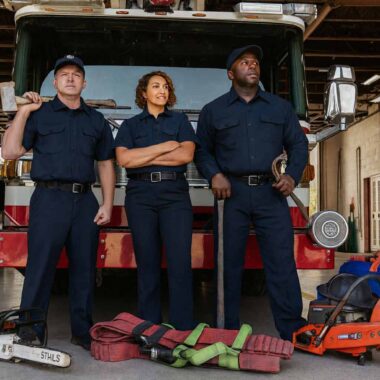
NFPA 1975 governs uniforms worn during station duties, training, apparatus operation, and routine work activities. These garments are not intended for direct firefighting, but they must limit injury risk if exposed to incidental heat or flame. Certification applies only to the outer garment as worn, not to base layers or clothing systems.
Vertical Flame Resistance
ASTM D6413 – Vertical Flame Test
Similar to NFPA 1977, fabrics are evaluated for after-flame and after-glow behavior. However, the performance intent differs: NFPA 1975 focuses on ensuring garments do not ignite readily or exacerbate injury, rather than providing sustained thermal protection.
Heat Exposure and Thermal Shrinkage
Garments are exposed to elevated temperatures to verify they do not melt, drip, or shrink excessively. This requirement is intended to reduce the risk of garments adhering to skin or creating secondary burn injury during unexpected exposure events.
Fabric Composition and Stability
NFPA 1975 verifies that materials—whether inherently flame resistant or treated—maintain their ignition resistance and thermal behavior after repeated laundering. This ensures consistent performance during routine stationwear use.
Garment-Level Heat Response
Testing applies to the entire finished uniform, including thread, trims, closures, and labels. All components must demonstrate predictable thermal behavior, reinforcing that NFPA 1975 certification is based on complete garment construction rather than fabric claims alone.
Laundering Durability and Identification
Uniforms are tested after multiple wash cycles to confirm continued compliance. Labeling and identification requirements ensure users can distinguish NFPA 1975–certified FR and certified Non-FR garments from non-compliant apparel in the field.
Key Distinctions Between NFPA 1977 and NFPA 1975
Although both standards use flame and heat exposure testing, they serve very different protective roles:
- NFPA 1977 is a performance-driven wildland firefighting standard, designed for environments where flame contact, radiant heat, and mechanical stress are expected.
- NFPA 1975 is a stationwear safety standard, intended to minimize injury risk during incidental exposure, not to provide firefighting-level thermal protection.
- NFPA 1977 garments must tolerate higher heat exposure, mechanical abuse, and environmental stress.
- NFPA 1975 garments, by contrast, are designed to not worsen burn injury, rather than to actively protect against sustained fire exposure.
Base Layers and FR Clothing Systems
Both NFPA 1977 and NFPA 1975 evaluate individual finished garments only.
Neither standard:
- Certifies base layers or undergarments
- Evaluates layering interactions
- Assesses system-level thermal performance
As a result, undergarments worn beneath certified outer garments can significantly influence burn injury outcomes, despite falling outside the scope of NFPA certification.
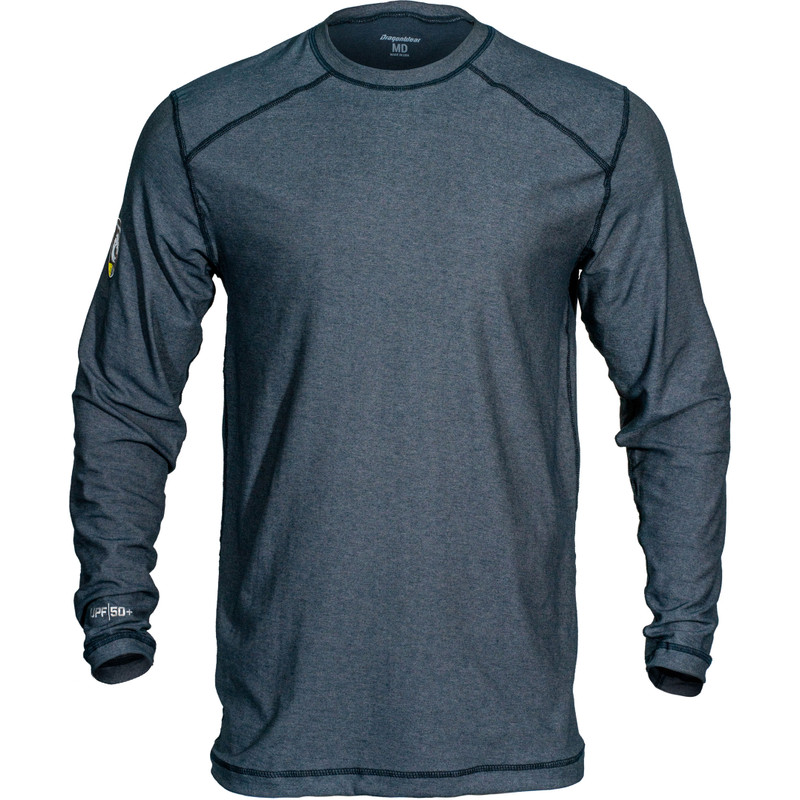
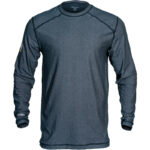
Because NFPA 1975 and NFPA 1977 do not address base layers, selecting purpose-built FR base layers—such as those from DragonWear—helps reduce hidden protection gaps and supports safer performance within layered clothing systems.